 David Henderson
Key Takeaways
- Washing the metal grease filters monthly prevents the majority of range hood faults, including restricted airflow and a grease-loaded blower wheel.
- VENT-BLOCK reports a restriction somewhere between the blower and the outside wall — the exterior damper and sagging flexible duct are the usual sites.
- A blower that has started to sound different is the early version of a blower that will seize: FAN-NOISE today is often FAN-FAIL a year later.
- Charcoal filters in recirculating hoods are replaced, not washed, and spent charcoal shows up as odors returning while airflow stays normal.
- NO-POWER on a hood over a gas range is an electrical question — switch the circuit off and have it checked rather than improvising.
The Bottom Line
Clean filters and a clear duct keep a range hood out of the repair queue almost entirely. If airflow is still poor with clean filters, the restriction is downstream, and if the fan has changed its sound, deal with it before it stops.
A range hood is the least maintained appliance in most kitchens and one of the easiest to keep working. Almost every call for GE range hood repair starts with something that could have been prevented by ten minutes of attention a few times a year: a grease-loaded filter, a duct nobody has looked inside since the house was built, or a switch that failed because it spent years being pressed with greasy fingers. The schedule below is what keeps a hood out of the repair queue.
| Task | How often | What it prevents |
|---|---|---|
| Wash the grease filters | Monthly with regular cooking | VENT-BLOCK, poor capture, fan strain |
| Wipe the hood canopy and the fan inlet | Monthly | Grease reaching the blower wheel |
| Replace charcoal filters (recirculating hoods) | As the manual specifies | Odors returning to the room |
| Check the exterior damper flap opens | Twice a year | VENT-BLOCK, back-drafts |
| Inspect the duct run for lint and grease | Yearly | VENT-BLOCK, fire risk |
| Test lights and every fan speed | Yearly | NO-LIGHT, SWITCH-FAIL going unnoticed |
The Filters Are the Whole Job
Metal grease filters sit in the underside of the hood and are the only thing standing between cooking vapor and the blower. They are designed to be washed, not replaced, and most slide or drop out by hand with a spring catch. Once they are saturated, three things happen at once: less air moves through the hood, grease begins to coat the blower wheel and the duct beyond it, and the motor works harder against the restriction.
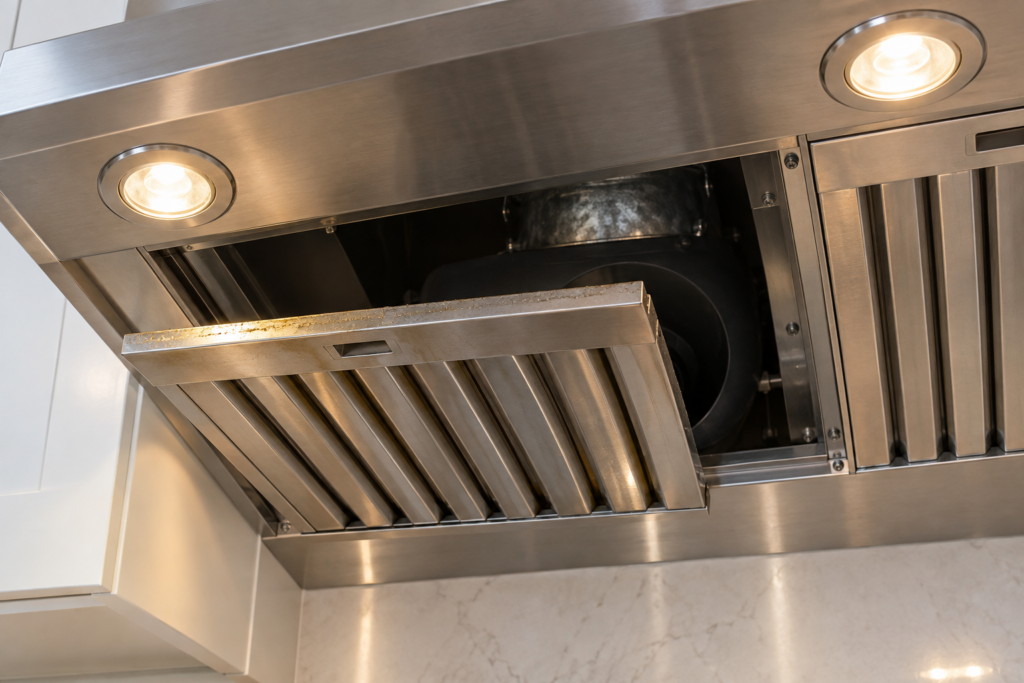
Wash them in hot water with a degreasing detergent, or run them through a dishwasher on their own if the manual allows it. Let them dry fully before putting them back — a damp filter collects dust immediately. If a filter has gone soft, buckled, or can no longer be cleaned back to bare metal, replace it; a compromised filter is a fire matter, not a cosmetic one.
Recirculating hoods, which discharge back into the room rather than outdoors, carry a charcoal filter behind the metal one. That filter is not washable and does need replacing on the schedule in your manual. A hood that has stopped controlling odors while still moving air normally is almost always telling you the charcoal is spent.
What Is Happening Beyond the Hood
A VENT-BLOCK report means the exhaust duct is blocked or restricted, and the hood is only able to detect the consequence, not the location. The restriction can be anywhere between the blower and the outside wall.
- The exterior damper. A hinged flap or louver on the outside wall or roof cap. Paint, a wasp nest or a bird screen packed with lint will hold it shut.
- Flexible duct sag. Corrugated flexible duct installed with slack traps grease at every low point, and each trap narrows the passage further.
- Long or crooked runs. A hood ducted with several elbows moves noticeably less air than the same unit on a short straight run, and it silts up faster.
- Combined runs. A hood sharing a duct with another appliance will back-draft and read as restricted whenever the other one runs.
Once a year, run the fan on high and hold a sheet of paper under the filters. If it will not hold itself against the intake, something downstream is restricting the flow, and cleaning the filters again will not fix it.
Noise Is the Early Warning
A blower that has started to sound different is telling you something before it fails. FAN-NOISE reports unusual vibration or sound, and the causes are ordinary: grease built unevenly on the blower wheel throws it out of balance, a mounting screw works loose, or a bearing begins to dry out.
FAN-FAIL means the exhaust fan is not spinning at all. Sometimes that is the motor, and sometimes it is a wheel seized solid in hardened grease — which is the same story as the noise, a year later. Between those two codes, a hood that is cleaned regularly rarely reaches the second.
Lights, Switches and Power
NO-LIGHT is normally the simplest fault on the hood, and on many units the lamp is accessible from below without removing anything structural. Use the lamp type the manual specifies: hoods run their lights in a hot, greasy environment, and a substitute bulb with the wrong rating tends to fail quickly or overheat the socket.
SWITCH-FAIL means the control switch is not responding. Mechanical rocker switches on older hoods wear out; membrane panels on newer ones fail where grease has crept behind the film. Cleaning the panel with a damp cloth rather than a spray helps it live longer — sprayed cleaner runs into the seams and does the damage you were trying to prevent.
NO-POWER is different in kind. A hood that is completely unresponsive is a wiring, breaker or connection question, and over a gas range in particular it is not the place for improvisation. Switch the circuit off and have it checked.
When to Hand It Over
- Clean the filters and the fan inlet first — it resolves a large share of airflow complaints outright.
- Check the exterior damper physically opens when the fan runs.
- Note whether the noise changes with fan speed; a noise that tracks speed points at the wheel, one that does not points elsewhere.
- Stop at anything electrical — the hood sits directly above an open flame or a hot surface.
Our range hood repair service covers the blower and motor, the switches and controls, the lighting circuit and the duct connection. Because the hood shares its cleaning schedule with the appliance underneath it, it is worth reading alongside our GE range and oven maintenance guide and booking both in one visit through preventive maintenance. Diagnostic work starts from $89, the final price is confirmed after the on-site diagnosis, and you receive a written estimate before any work begins. Book a visit or tell us what the hood is doing and we will say whether it needs one.