 David Henderson
Key Takeaways
- The GE dryer sensor dry setting reads moisture through two metal bars in the drum; a waxy film from softener or dryer sheets fools it.
- Unplug the dryer and wipe both bars with a cloth dampened with rubbing alcohol; most Sensor Dry problems end there.
- Repeat the cleaning every few months if you use dryer sheets, more often with liquid softener.
- A restricted vent and a film-coated lint screen mimic a bad sensor, so rule them out next.
- Thermistor codes E02, E03 and E05 are a different fault and a separate guide.
The Bottom Line
A GE dryer that ends Sensor Dry too early, or never, most often has dirty sensor bars rather than a failed part. Clean them, check the vent and the lint screen, and book a visit only if the problem persists.
The GE dryer sensor dry setting is meant to stop the cycle when the clothes are dry, and when it fails it fails in two opposite ways: it quits while the towels are still damp, or it never decides they are dry and runs on until the timer gives up. Both come back to the same small part, and in most homes the fix is a five-minute cleaning rather than a repair.
| Symptom | Likely cause | First action |
|---|---|---|
| Sensor Dry ends with damp clothes | Film on the sensor strips reads wet fabric as dry | Clean the strips |
| Cycle runs very long or never ends | Dirty strips, or a restricted vent | Clean the strips, then check the vent |
| Clothes dry on Timed Dry but not Sensor Dry | The sensor is the weak link | Clean it; book service if it persists |
| E02, E03 or E05 on the display | A thermistor code, not the strips | Stop and read the thermistor guide |
Why Is the GE Dryer Sensor Dry Not Working?
Most often because the sensor strips are coated, not because anything has broken. The strips measure how easily a tiny current passes through the damp fabric touching them. Fabric softener and dryer sheets leave a thin waxy film that insulates the metal, so the dryer reads less moisture than there is and ends the cycle early, or cannot read a clean signal at all and keeps running.
The same film explains why a dryer can seem fine with cottons and wrong with synthetics: light fabrics dry fast and hold less moisture, so the sensor has less signal to work with and a coated bar tips the result sooner. Clothes that come out damp at the seams, with dry cuffs, are the usual sign.
That is why the problem builds slowly. A dryer that behaved perfectly for years begins finishing early, then very early, and the household blames the machine when a cloth and a little rubbing alcohol would have fixed it. If your GE dryer sensor dry not working complaint started gradually, the film is the first suspect. If it started suddenly, after a move, a repair or a change of vent, look at what changed in the laundry room before you look at the dryer.
Where Are the Sensor Strips and What Do They Do?
They are two curved metal bars inside the drum, usually near the front edge of the drum opening or on the inner face of the drum, depending on the model. They look brighter than the painted surface around them. Wet clothes tumbling across both bars complete a small circuit; the wetter the load, the better it conducts, and the control watches that signal fall as the clothes dry.
- Two bars, not one. The signal needs both, so a film on either one distorts the reading.
- Metal, not painted. Bare metal is what conducts; a painted or coated bar cannot do its job.
- Separate from the thermistors. The temperature sensors sit in the airflow and have their own codes.
- Only as good as the contact. Clothes have to touch both bars, so a drum that is too full or too empty gives a weak reading.
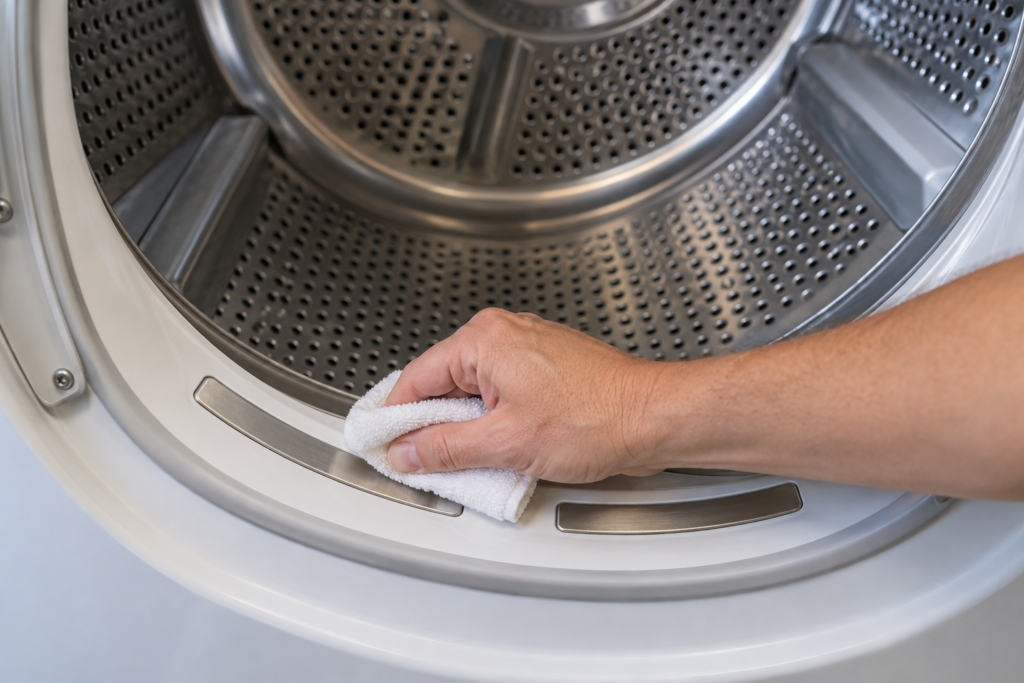
How Do You Clean the Sensor Bars?
Unplug the dryer, wipe the bars with a cloth dampened with rubbing alcohol, and dry them. This takes a few minutes and needs no tools.
- Unplug the dryer and let the drum cool if you have just run a load.
- Find both bars by feel and sight; they are the bare metal strips in the drum.
- Wipe with rubbing alcohol on a cloth or a cotton pad, using firm strokes until the cloth comes away clean rather than waxy.
- Dry them with a clean cloth. Use a fine non-metal scouring pad only on stubborn buildup, never a steel one.
- Test with a damp load. Run a small Sensor Dry cycle with a few damp towels and see whether it ends sensibly.
Repeat every few months if you use dryer sheets, and more often with liquid softener. Our GE dryer maintenance guide places this task in a full schedule with the lint screen and the vent.
What Else Makes a Sensor Dry Cycle Run Too Long or Stop Too Soon?
A restricted vent and a coated lint screen are the other two common causes, and both mimic a bad sensor. A clogged vent traps moist air so the load never finishes, and a lint screen sealed with softener residue chokes the airflow in the same way. If clean strips do not help, rule these out before suspecting a part.
- Lint screen film. Run water over the screen; if it beads rather than soaking in, the film is blocking airflow, and a scrub with warm soapy water clears it.
- Vent length and bends. A long, kinked or crushed vent holds moisture and lengthens every cycle.
- Overloading. A packed drum cannot tumble, so the clothes never touch the strips evenly.
- Mixed loads. A single heavy item with light ones can end the cycle on the light ones' reading.
How Often to Clean the Bars and What to Avoid
Every two to three months suits most households, and every month suits a household that uses liquid softener or several dryer sheets per load. The film builds faster than people expect, and it builds on the lint screen at the same rate, so the two jobs pair naturally. Keep the cleaning gentle, because the bars are thin metal and a harsh abrasive can mark the surface the sensor depends on.
- Skip steel wool. It scratches the bars and leaves fibers behind.
- Skip wet cleaners and sprays aimed at the drum; use a dampened cloth and dry it.
- Reduce the sheets. One sheet, or wool dryer balls, leaves far less film than two or three.
- Watch the finish times. A cycle that creeps longer over a few weeks is the early warning.
If you would rather not guess at the interval, a short note on the laundry-room wall with the date of the last cleaning does more than any reminder app.
When It Is Not the Sensor
If the strips are clean, the vent is clear and Sensor Dry still misbehaves, the fault is probably wiring or the control, and it needs a technician. A temperature problem looks different: a dryer that does not heat enough or overheats usually posts a thermistor code, and our GE dryer thermistor error codes guide covers E02, E03 and E05, with the E05 page for the open-circuit case.
For symptoms short of a code, the broader GE dryer not drying guide runs the full list. The price is confirmed on site, and in writing, before any part is ordered. Dryer repair covers the sensor circuit, the thermistors and the vent check, and you can schedule a visit or contact us with what the dryer is doing.