 David Henderson
Key Takeaways
- E42 on a GE Profile washer means the motor inverter detected an overload and cut the spin.
- An overloaded drum costs nothing to fix: wash smaller loads and reset.
- A faulty inverter board is a contained repair worth doing on an otherwise sound washer.
- Worn drum bearings are the heavy case, and on an older washer the quote deserves comparison with a replacement.
- Turn the empty drum by hand with the washer unplugged: stiff or grinding points at bearings, smooth points at the load or the board.
The Bottom Line
GE Profile washer E42 repair or replace is decided by cause: overloads cost nothing, a board is a reasonable repair, and bearings on an old washer are the case for replacing. The price is confirmed after diagnosis.
E42 on a GE Profile washer arrives mid-spin: the drum slows or stops, the display posts the code, and the cycle will not finish. It sounds like a verdict, but E42 only says the motor inverter saw too much current, and what you do next depends on why. Some causes cost nothing and some end a washer's life, which is why the code deserves a decision made by cause rather than by panic.
| Cause behind E42 | Who fixes it | Repair or replace |
|---|---|---|
| Overloaded drum | You | Neither; wash smaller loads |
| Worn drum bearings | Technician | Weigh against age; often a major job |
| Faulty inverter board | Technician | Repair if the washer is otherwise sound |
| Motor heat, with E4B | You, then technician | Repair; fix the cooling or the rest periods |
What Does E42 Mean on a GE Profile Washer?
The short answer is that the washer protected itself. An inverter-driven motor is controlled electronically, and when the inverter sees current rising past its limit it stops the motor before the windings or the board are damaged. The fault is therefore in whatever made the motor work too hard, not in the protection.
E42 means the motor inverter detected an overload, meaning the motor was drawing more current than the control allows. The inverter protects the motor and itself by cutting the spin, so the code appears when the drum is hard to turn, when the load is too heavy, or when the board that regulates the motor is no longer reading normally.
A heavy, wet load is the most common trigger, because water-laden towels and bedding can double the weight the motor must turn at spin speed. The symptoms narrow it down. A washer that shows E42 only with comforters, jeans or towels points at overloading. A drum that feels stiff or grinds when you turn it by hand with the power off points at bearings. E42 with a small, balanced load and a free-turning drum points at the board. The E42 code page lists these symptoms and the reset: unplug for 60 seconds, or on Profile models power off, wait 30 seconds and power on.
GE Profile Washer E42 Repair or Replace: What Each Cause Points To
Decide by cause, in order of cost to you. An overloaded drum is free to fix by washing smaller loads, and no repair or replacement is involved. A faulty inverter board is a contained electronic repair that is generally worth doing on a washer that is otherwise sound. Worn drum bearings are the heavy case: replacing them often means removing the drum from the cabinet, and on an older washer that labor can approach the price of a newer machine.
- Overload: change the habit, reset, and the code should not return.
- Inverter board: repair when the washer is under roughly eight years old and the drum turns freely.
- Bearings on a young washer: repair is reasonable, particularly under warranty.
- Bearings on an old washer: compare the quote against replacement before committing.
Age is a rough guide and condition is a better one. A washer with a clean drum, an intact door seal and no history of leaks has more life left than its date suggests, and a washer with rust, a leaking tub or a second fault is closer to the end than it looks.
How Do You Tell an Overload From a Bearing Problem?
Turn the empty drum by hand with the washer unplugged. A healthy drum spins fairly freely; a failing bearing makes it feel stiff, rough or noisy, and it grinds. If the drum is smooth and E42 appears only with big loads, it is overloading.
- Unplug the washer and empty the drum completely.
- Turn the drum by hand and listen for grinding or a rough, catching feel.
- Note which loads trigger it: every cycle, or only heavy ones.
- Wash one small, balanced load after a reset and see whether E42 returns.
Excessive vibration and thumping before the stop usually come from an overloaded or unbalanced drum; keep that distinction in mind when you describe it to the technician. Repeated overloads are not harmless, either: the page warns that repeated motor overloads can damage the inverter board and the motor windings, so a washer that keeps tripping E42 on heavy loads should be left alone with those loads until the cause is known.
If the drum is smooth and the load was ordinary, write that down. It is the single most useful fact you can give a technician, because it moves the likely cause from the drum to the board, and the board is the repair that most often keeps a Profile washer in service.
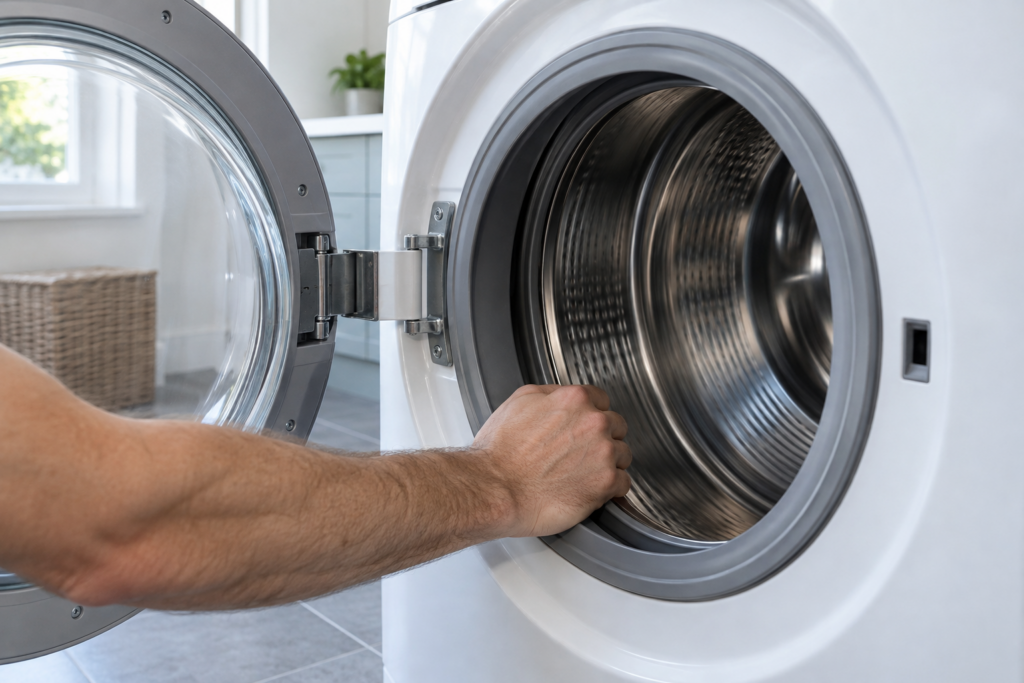
When E4B, E30 or E60 Join E42
A second code changes the picture, so note both. E4B means the motor overheated, and the page suggests resting a Profile front-loader for about 30 minutes between large loads and keeping the motor area ventilated; see the E4B page. E30 is a drain pump that is not responding, covered on the E30 page, and E60 is a door lock failure, on the E60 page.
- E42 with E4B: heat is the thread; check ventilation and spacing of heavy loads first.
- E42 with E30: water left in the drum makes the load heavy; clear the drain and try again.
- E42 with E60: a lock fault interrupting the spin; a small repair, not a verdict on the washer.
What a Visit for E42 Involves
The technician starts by separating the three causes, because the quote depends on which one it is. That means turning the drum by hand, checking the load history and the balance, reading the inverter's behavior at power-up, and looking for a second code. Only then is a part named.
- Drum check. Free rotation or resistance tells bearings from the rest.
- Load and balance review. Overloading is ruled in or out first because it costs nothing.
- Inverter check. The board is tested before it is replaced, since a false overload reading is its signature.
- Written estimate. The final figure is confirmed on site before any part is ordered.
A short list of what you noticed helps more than a theory: which loads, how often, whether the drum feels stiff, and whether a second code appeared.
Should You Repair an Older Profile Washer?
Repair if the fault is contained and the washer has years left, and replace if the repair is a heavy one on a machine that is already tired. The deciding facts are age, the cause, and whether anything else is failing. The parent guide on repairing or replacing a GE washer sets out the whole-appliance rules, and GE washer repair cost shows where each repair sits. If the drum simply will not spin, GE washer not spinning runs the broader checklist.
The price is confirmed after diagnosis, with a written estimate before any part is ordered. Washer repair includes the inverter, the drive and the drum, and you can schedule a visit or contact us with the codes you saw and how heavy the loads were.