 David Henderson
Key Takeaways
- ICE-JAM means the built-in ice maker's auger or chute is physically blocked — a mechanical fault, not an electrical one.
- This is a different appliance from the GE Opal countertop ice maker, which has its own codes and its own repair-or-replace guide.
- The auger and motor are a serviceable module, and repair is almost always the right call over full ice-maker replacement.
- A jam that keeps returning after clearing it by hand usually means the auger motor or gear is wearing out.
- Diagnostic work starts from $89 and confirms whether the fault is the auger, a water inlet valve, or a control issue.
The Bottom Line
GE ice maker auger repair or replace: repair, almost every time. The auger module is inexpensive to replace compared to the ice maker assembly, and full replacement is rarely needed unless the mold tray or board is also damaged.
Repair, not replace — that is the short answer for the built-in ice maker's auger when it jams. This is about the ice maker built into a GE French-door or side-by-side refrigerator, not the countertop GE Opal ice maker covered elsewhere on this site — the two are different products with different parts, and the auger sits behind a specific code, ICE-JAM, on the built-in unit only.
| Code | What it means | Repair or replace |
|---|---|---|
| ICE-JAM | Auger or chute blocked | Repair — usually an auger or motor issue |
| NO-ICE | No ice production at all | Diagnose before deciding |
| ADD-WATER | Water supply not reaching the unit | Repair — usually the supply line |
| UNIT-HOT | Ice maker compartment too warm | Repair — check door seal and vents |
What Does the GE Ice Maker ICE-JAM Code Mean?
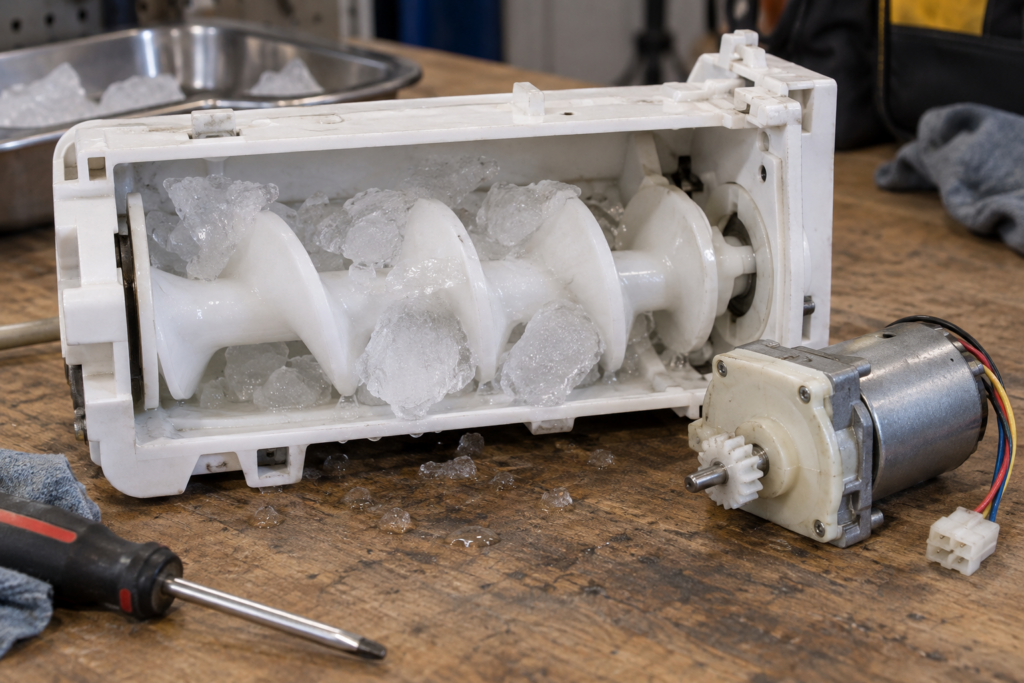
ICE-JAM means the auger — the plastic or metal spiral that pushes formed ice out of the tray and into the dispenser chute — or the chute itself is physically blocked. This is a mechanical fault rather than an electrical or sensor one, which is part of why it is usually a repair rather than a full ice-maker replacement question. GE's own code page describes it plainly: something is stopping the auger from turning freely, and the motor driving it can burn out if the jam is left in place and the unit keeps trying to force it.
The most common cause is a clump of fused ice built up from cubes that partially melted and refroze together, often after a door was left open or the unit sat unused for a while. Less often, the auger's own gear or coupling has worn out, in which case the jam is really a symptom of a part that needed replacing anyway.
Common Causes of an Ice Maker Auger Jam
A handful of patterns cover most of the ICE-JAM calls we see:
- Partial melt-and-refreeze. A freezer door left ajar, or a power blip, lets cubes soften just enough to fuse into one solid mass the auger cannot turn against.
- Overfilled ice bin. Ice packed above the auger's reach jams the mechanism from the top down rather than the bottom.
- A worn auger gear. Plastic gear teeth wear down over years of use, and a worn gear slips under load instead of turning cleanly.
- A cracked coupling. The coupling connecting the motor shaft to the auger itself can crack, which looks identical to a jam from the outside but needs a part replaced, not just ice cleared.
- Low water pressure feeding the mold. Undersized cubes that never fully form are more likely to fuse into odd shapes that jam the auger.
GE Ice Maker Auger Repair or Replace
Repair, in almost every case. The auger and its drive motor are a serviceable module in GE refrigerators — they unclip as a unit rather than requiring the whole ice maker assembly to be swapped — and the part cost is modest compared to what a full ice-maker replacement runs. Replacing the entire ice maker only makes sense when the auger fault turns out to be secondary to a cracked mold tray or a failed control board, which a diagnostic visit will catch before any part is ordered.
- Clear obvious ice clumps first with the unit powered off — a flashlight and a plastic tool, never metal, which can crack the tray.
- Book a diagnostic if the jam returns after clearing it, since a recurring jam usually means the auger motor or gear is wearing out.
- Replace the auger module if the motor tests weak — this is the point where "repair" means a specific part swap, not a guess.
- Consider full ice-maker replacement only if the mold tray or control board is also damaged, which is uncommon.
Our guide to GE refrigerator repair or replace covers the whole-appliance version of this decision — the ice maker auger question sits well inside that framework as one of the least expensive parts to fix on the list, which is worth knowing before assuming a refrigerator issue means starting over.
How Is This Different From the GE Opal Ice Maker?
The Opal is a standalone countertop nugget-ice maker, sold and serviced as its own appliance with its own error codes and its own repair-or-replace guidance on this site. The built-in ice maker covered here lives inside the refrigerator freezer compartment, runs off the refrigerator's own water line and control board, and posts a completely different set of codes — ICE-JAM, NO-ICE, ADD-WATER, UNIT-HOT and CLEAN. If your countertop unit is the one acting up, that other guide is the right one; this one is specific to the built-in auger and its parts.
Owners searching for ice-maker help sometimes land on the wrong guide simply because "ice maker" describes both products, and the two repair conversations are genuinely different. The Opal's decision is closer to a small-appliance repair-or-replace call, weighed against the price of a new countertop unit. The built-in auger's decision is closer to what this guide covers: one module inside a refrigerator that is otherwise doing its job, where the part itself is inexpensive relative to the appliance around it.
A few quick ways to tell which unit you actually have:
- Countertop and portable with its own power cord and a small reservoir you fill by hand — that is the Opal.
- Built into the freezer compartment with a permanent water line running to the refrigerator — that is the unit this guide covers.
- Display shows ICE-JAM, NO-ICE, ADD-WATER, UNIT-HOT or CLEAN — built-in unit, this guide applies.
- Display shows an Opal-specific code — the Opal guide linked above is the right one to read next.
What Does Fixing the Ice Maker Auger Cost?
Diagnostic work on a GE refrigerator ice maker starts from $89, which confirms whether ICE-JAM is a clog you can clear yourself, a worn auger module, or something upstream like a failed water inlet valve behind the related NO-ICE code. The auger module itself is one of the less expensive refrigerator parts to replace, and the final price is confirmed in writing before the part is ordered.
Our ice maker repair service covers the auger, the water inlet valve, and the mold tray in one visit. Schedule a visit if clearing the ice by hand does not solve a repeat jam — an auger motor that keeps forcing against a blockage does not usually recover on its own, and full details on the fault code itself are on the ICE-JAM code page. Most auger repairs are done and tested the same visit, since the module is designed to be serviced without pulling the whole refrigerator away from the wall or draining the water line completely. A technician typically runs a full ice-making cycle after the repair before leaving, rather than just confirming the auger turns freely by hand, since a module that spins without a load can still bind once ice starts forming against it.