 David Henderson
Key Takeaways
- Only the model and serial number from your own rating plate can answer whether a recall covers your unit — two identical-looking microwaves can fall on opposite sides of the boundary.
- The US Consumer Product Safety Commission database and the manufacturer's own safety page are the authoritative sources; forums and search snippets go out of date.
- A recall remedy is carried out free of charge by the manufacturer or its appointed service, so check the register before booking a paid repair.
- Codes such as F1, F2, F3 and F7 are ordinary component faults, not evidence of a recall — but they are still a reason to stop using the unit.
- Never open a microwave cabinet yourself: the high-voltage capacitor holds a charge long after it is unplugged.
The Bottom Line
Photograph the rating plate, then check the model and serial against the CPSC database and the manufacturer's safety page. If the unit is listed, take the remedy offered; if it is not, you are looking at an ordinary fault and a diagnostic will name it.
Searches for a GE microwave recall spike every time a safety notice makes the news, and almost every one of them is asking the same private question: is mine one of them? That question has a definite answer, and it does not come from a headline or a forum thread. It comes from the model and serial number printed on your own machine, checked against the official register. This guide shows where those numbers are and how to check them properly.
| Where to check | What it tells you | What you need in hand |
|---|---|---|
| US Consumer Product Safety Commission database | Every recall officially announced in the US, by product | Brand, product type, model number |
| The manufacturer's own recall or product-safety page | Its current notices and the remedy offered | Model and serial number |
| Product registration you completed at purchase | Direct notification if your unit is affected | Nothing — they contact you |
| The rating plate on the appliance | The two numbers every check depends on | A flashlight and a phone camera |
| The retailer or installer who sold it | Purchase date and the exact unit shipped | Order number or receipt |
Find the Model and Serial Number First
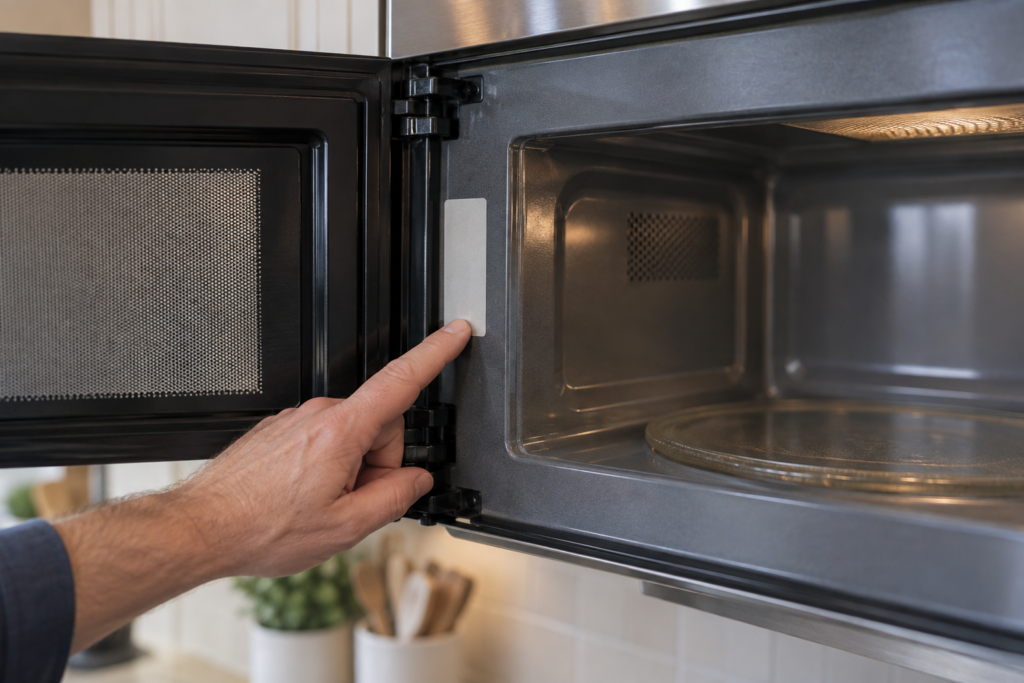
Nothing about a recall check works without these two numbers, and on a microwave they are easy to miss because the plate is rarely on the outside. On an over-the-range unit, open the door and look along the inner frame of the cabinet, usually on the left-hand side behind the door opening. On a countertop model the plate is normally on the rear panel or underneath. Built-in units generally carry it on the frame behind the trim, visible when the door is open.
Photograph the plate rather than copying the numbers out by eye. Model numbers on appliances mix letters and digits in patterns where a misread character changes which product you are looking at entirely, and a recall list is exactly the place where that error matters.
How to Check Whether Your Unit Is Included
A recall applies to a defined production range, not to a product line. Two microwaves that look identical on the kitchen wall can sit on opposite sides of a recall boundary because they were built months apart. That is why the serial number matters as much as the model.
- Search the official database, not a search engine. The US Consumer Product Safety Commission maintains the authoritative list of recalls announced in the United States, and it is searchable by brand and product type.
- Check the manufacturer's own product-safety page. It will state the remedy — repair, replacement or refund — and the procedure for claiming it.
- Match the full model and serial, character for character. A partial match is not a match.
- Do not rely on a store or a forum. Secondhand accounts of recalls go out of date, and details get garbled in retelling.
- Register the appliance if you never did. Registration exists mainly so the manufacturer can reach you if a safety notice is issued later.
If your unit is listed, follow the remedy the notice specifies and nothing else. A recall remedy is carried out by the manufacturer or its appointed service network, free of charge to you, and having an independent shop modify the appliance first can complicate the claim.
Symptoms That Look Alarming but Are Not Recalls
A microwave behaving strangely is not evidence that it has been recalled. Several common faults produce symptoms that feel like a safety notice waiting to happen and are in fact ordinary component failures with ordinary repairs behind them.
An F1 code is an open thermal sensor and F2 is a shorted one. Both concern the sensor that reports oven-cavity temperature to the control, and both mean the machine should be stopped — not because of a recall, but because a magnetron running with no reliable temperature feedback is genuinely not something to leave working. F3 is a shorted touchpad panel, which is why some units start themselves or refuse to respond, and F7 is a single stuck key doing a milder version of the same thing.
A unit that runs but does not heat, sparks around a worn waveguide cover, or hums much louder than it used to, is describing a fault, not a campaign. What all of these share with a real recall is the right response: stop using it and have it looked at.
What To Do While You Are Waiting for an Answer
If you have reason to think your microwave may be affected, or it is behaving in a way that worries you, treat it as out of service until you know.
- Unplug it if it is a countertop unit, or switch off the breaker if it is hardwired over the range.
- Do not open the cabinet. A microwave's high-voltage capacitor can hold a dangerous charge long after the unit is unplugged, and this is the one appliance where that warning is not boilerplate.
- Photograph the rating plate and the fault so you have both when you make the check.
- Keep the receipt or order confirmation — remedies usually depend on establishing the purchase.
- Check the register before you book a paid repair, because a covered remedy costs you nothing.
Our broader GE appliance recall checklist runs the same procedure across every appliance in the kitchen, which is worth doing once rather than one machine at a time. If the check comes back clear and the fault is real, our microwave repair service covers the control panel, the sensors and the door interlocks. Diagnostic work starts from $89, the final price is confirmed after the on-site diagnosis, and you receive a written estimate before any work begins. Book a visit or send us the model number and we will tell you what we can see from it.