 David Henderson
Key Takeaways
- A recall applies to particular models and build periods, so only your own model and serial number can answer the question.
- Check the rating plate on the range, then the official U.S. recall database, Health Canada for Canadian units and the manufacturer.
- Do not rely on summaries on repair or review sites for the facts of a recall.
- If your range is listed, follow the remedy in the official notice and do not attempt your own fix.
- Most range hazards are not recalls, so keep the everyday safety checks going either way.
The Bottom Line
Read the model and serial number off the plate, check them against the official sources and follow the notice if they match. A fault that is not a recall is a diagnosis job, and the price is confirmed after diagnosis with a written estimate before work begins.
Searches such as "GE stove recall", "GE electric range recalls" and "GE gas range recalls" all lead to the same practical question: does my range appear on an official list? A list of campaigns cannot answer that, because a recall applies to particular models built in a particular period, and the only reliable answer comes from matching the model and serial number on your own range against an official source. This guide describes how to do that, which sources to trust and what to do with the answer. It states no recall details of its own on purpose: dates, models and remedies belong to the agencies and the manufacturer, and a copy on a repair site can be out of date.
| Step | What to do | Where to look |
|---|---|---|
| 1 | Find the model and serial number | The rating plate on the range frame |
| 2 | Search the official U.S. recall database | The Consumer Product Safety Commission, cpsc.gov |
| 3 | Search the Canadian database if relevant | Health Canada's recall listings |
| 4 | Check the manufacturer's own notice | The GE Appliances recall and safety pages |
| 5 | Keep a record of what you found | A photo of the plate and a note of the date |
How Do You Check for a GE Range Recall?
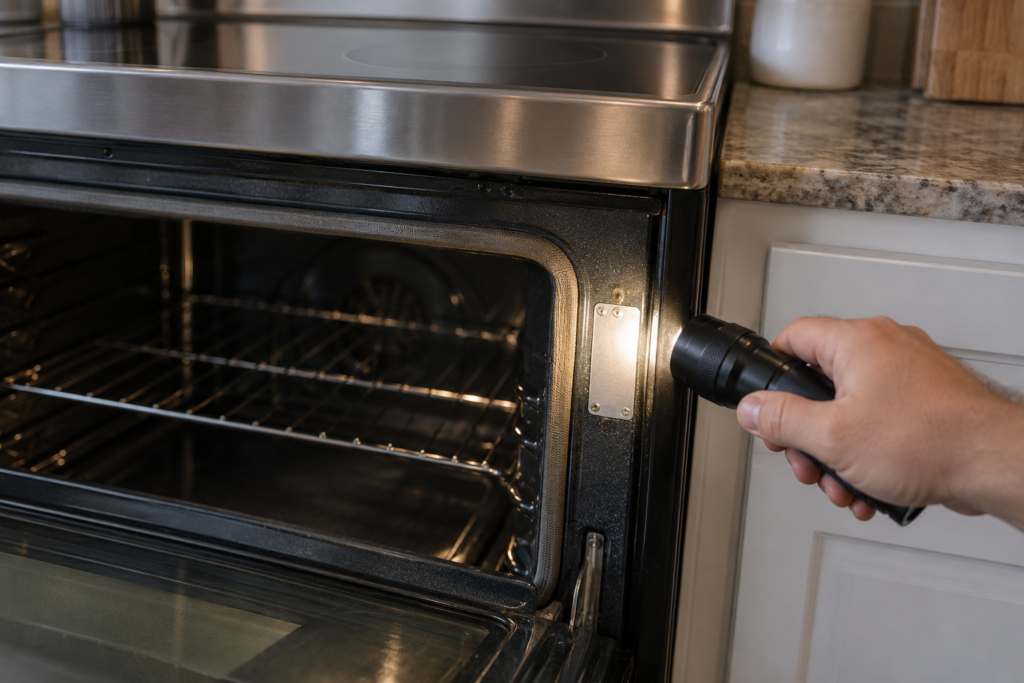
Read the model and serial number off the rating plate and compare them with the official lists, never with a general description. On many ranges the plate is on the frame and becomes visible when the oven door is open, but its position differs by model, so check the installation guide if you cannot find it. A GE range recall, if there is one for your model, is identified by those numbers, and a match on the model alone is not always enough because the serial number often marks the build period.
- Photograph the plate. You will need the numbers more than once.
- Write down the full model number. Letters and digits both count.
- Note the serial number. It can decide whether your unit is covered.
- Record the purchase date if you have it. Helpful for any claim later.
Which Sources Can You Trust for a GE Stove Recall?
Three: the Consumer Product Safety Commission in the United States, Health Canada for Canadian units, and the manufacturer's own pages. Anything else, including a summary on a repair, review or news site, is a pointer at best, and that includes this guide. Use it for the method and use the official pages for the facts.
The same rule applies to a notice you receive in the mail or by email. A genuine notice names the model and gives a way to contact the manufacturer through its official channels; one that asks you to pay, or to share account details, should be checked against the official sources before you respond.
- Search by the model number, not the product name. Names are shared across many ranges.
- Use the official search pages. Type the address yourself rather than following a link in a message.
- Do not rely on a forum post. Even a correct one may be out of date.
What a Recall Notice Contains
A genuine notice follows a consistent shape, and knowing it helps you read the result of your search. It describes the product and the hazard in plain language, lists the model numbers and the period in which the units were sold or built, says what the owner should do and how to reach the manufacturer. Some notices ask you to stop using one function and keep using the rest. Others describe a repair or a replacement part that the manufacturer supplies.
- The hazard. What can go wrong and under which conditions.
- The affected models and dates. Matched against your plate, not against the product name.
- The remedy. A repair, a part, a replacement or a refund, as the notice specifies.
- The contact route. The manufacturer's official channel, which is how a claim is made.
If the notice and your range disagree about a model number, assume nothing: copy the digits exactly as they appear on the plate and search again, and if there is still doubt, ask the manufacturer through the official route in the notice.
What Should You Do If Your Range Is Listed?
Follow the remedy in the official notice, and stop using the affected function if the notice tells you to. The remedy for a recalled product is set by the manufacturer and the agency, and it is usually free of charge to the owner. A repair site cannot change it, and a technician who is not authorized for the recall repair should not improvise one.
- Read the whole notice. The instructions about continuing to use the range are in it.
- Contact the manufacturer through the official channel. The notice gives the route.
- Keep the paperwork. The notice, the reference number and any messages.
- Do not attempt your own fix. A range combines gas or high-voltage power with high heat.
Until the remedy is done, use common sense about the range: if the notice says to stop using it, stop, and if it names one burner or function, avoid that one. A technician from this site can inspect the range for any other fault, but a recall repair itself follows the manufacturer's instructions.
What If No Recall Applies?
Then the range still needs ordinary attention, because most range fires and burns have nothing to do with a recall. The safety pages for ranges on this site cover the points that matter every day. The GE gas range safety guide covers gas supply and ignition, the notice on range child lock safety covers the controls, and the notice on oven self-clean at high temperature explains the self-clean cycle.
- Check that nothing flammable is near the cooktop. Towels, bags and cartons do not belong there.
- Watch for a smell of gas. Leave the house and call the gas utility from outside.
- Treat a stop-use code as a stop. Codes such as F2 exist for a reason.
When to Bring In a Technician
For anything that is not a recall: a code on the display, a burner that will not light, an element that sparks or an oven that overheats. A recall check tells you whether a known problem applies to your model, and it says nothing about a fault that has developed on your own range. A diagnostic visit starts from $89, with the final price confirmed after diagnosis and a written estimate before any work begins.
For the wider routine, see our GE appliance recall checklist, which applies to every appliance in the house, and the guide to what to do on a recall alert before you call a technician. To arrange an inspection, schedule a visit or read about GE range repair.