 David Henderson
Key Takeaways
- On a sound electric oven a failed broil element is almost always worth replacing, because it is a simple, inexpensive part.
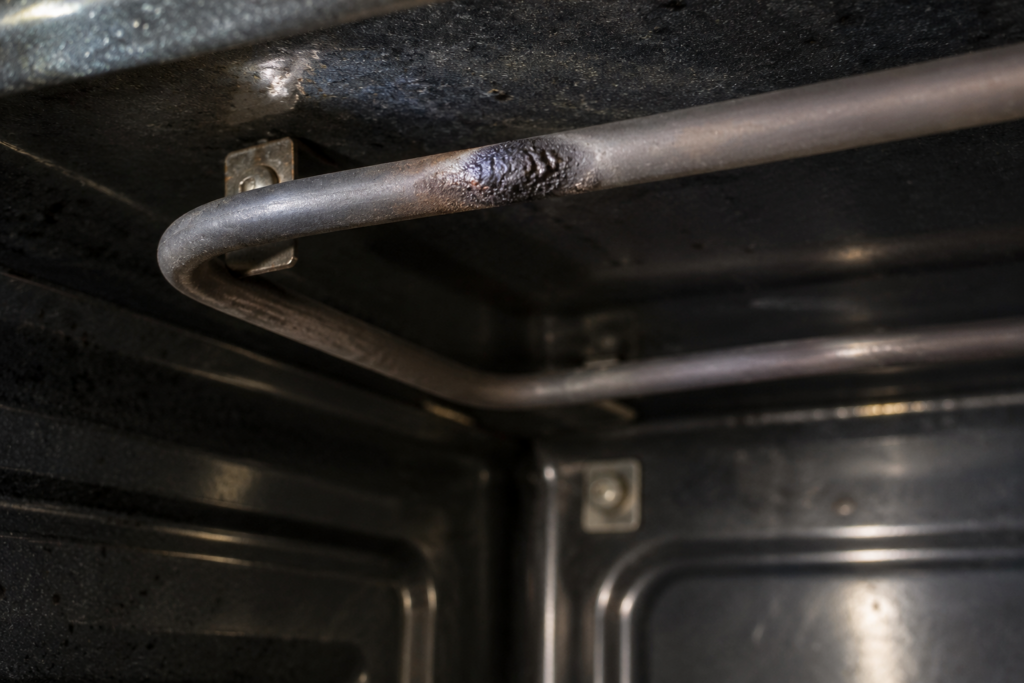
- A blister, a break or a half-dark element on a cold oven is the visible sign of the failure.
- A working bake element with a dead broiler points to the broil element or its circuit, not the whole oven.
- A sensor fault, an overtemperature fault or a control board fault can imitate a broil element failure.
- The age of the range and other faults decide the question once the element is only one of several problems.
The Bottom Line
Replace a visibly failed broil element on a sound oven, diagnose first when there is no visible damage, and weigh the age of the range when other faults appear. The price is confirmed after diagnosis, with a written estimate before work begins.
An electric oven that bakes but will not broil, or broils with one half of the element glowing and the other half dark, is one of the more common complaints about an older range. The broil element is a simple part, a heated rod across the top of the oven cavity, and it is also the one part of a failing oven where the repair question has a clear answer more often than not. This guide is about that single part, not the whole range, and it explains when replacing the element pays off, when something else on the oven decides the question and when the quote deserves a second look.
| Situation | Worth fixing? | Why |
|---|---|---|
| Broil element visibly blistered or broken, oven otherwise fine | Yes | One simple part restores the function |
| Bake and broil both dead | Find the cause first | Often a sensor, relay or board, not the elements |
| Broil is weak but the element glows | Possibly | May be a wiring, relay or control issue |
| Element failure plus a control board fault | Weigh the age | The board decides the total |
| Oven near the end of its life with cavity damage | Probably not | Spending on a worn oven rarely pays back |
Is a GE Oven Broiler Element Worth Fixing?
On a sound electric oven, yes, in almost every case. The repair is the straightforward kind: the part is one of the cheaper ones in the oven, the failure is visible and the rest of the range is usually unaffected. Our guide to whether a GE range is worth repairing places bake and broil element repairs among the failures that should not prompt replacement at any reasonable age.
The picture changes only when the element is not the whole story. A broil element that has failed on an oven with a worn control, a cracked cavity or a history of other faults is a different decision, and the age of the range matters more than the part.
Signs the Broil Element Has Failed
Look at it. With the oven off and completely cold, the element across the top of the cavity usually shows the damage that explains the symptom. Switch off the oven's breaker if you intend to touch anything, and never reach into a hot oven.
- A blister or bubble. A raised, bubbled spot on the rod is a common failure point.
- A visible break or a burnt-through gap. The element no longer carries current across its full length.
- Uneven glow when broiling. One section glows and the rest stays dark.
- Bake works and broil does not. The elements are separate circuits, so a working bake element points away from the whole oven.
- Scorch or arcing marks at the terminals. A loose connection can damage both the element and its wiring.
Take a photo of what you see before you call. A clear picture of the element, with the oven cold, tells a technician whether the visit is a straight part swap or a longer diagnosis, and it helps with ordering the right part. Note too how the oven behaved before it failed: a sudden loss of broil points to a break, while a slow fade over several weeks points to an element that has been wearing out, or to a connection that has been getting worse.
Check the rack position as well. Broiling on a rack set too close to or too far from the element can make a healthy element look weak, and it takes only a minute to move the rack and test again.
What Else Can Cause Weak Broiling?
Several things look like an element failure and are not. The oven-not-heating guide on this site, GE oven not heating, walks through the wider list, and the code pages narrow it for a specific fault.
- A temperature sensor fault. The F3 page describes an open oven sensor circuit and says to stop using the oven until it is checked.
- An overtemperature fault. The F2 page covers an oven overtemperature fault and treats it as a stop-use code.
- A control board fault. F1 and FF are the codes the pages tie to control board failure.
- Setting or mode. A broil setting selected on the wrong rack, or a door left open when the model expects it closed, changes how the broiler behaves.
If the element looks intact and the oven shows no code, the next step is a diagnosis rather than a part. Replacing an element that has not failed is the most common way to spend on this repair and still have no broil.
Can You Replace the Element Yourself?
Some owners do, but it is electrical work on an oven wired to a high-voltage supply, and it is only appropriate with the oven's breaker switched off and the oven cold. The element is the part the guides on this site call one of the simplest oven repairs, held by a couple of screws with two wire connections. The risk is not the part but the wiring: terminals that have overheated, brittle insulation or a connector that has to be matched exactly.
- Switch off at the breaker, not at the control. The display being dark does not mean the oven is isolated.
- Use the exact part for the model. Elements differ in length, shape and rating.
- Stop if the wires are scorched. That is a wiring repair, and it belongs to a technician.
- Do not use a gas oven's broiler the same way. A gas broiler is a burner with an igniter, and gas work is never a homeowner job.
When the Age of the Range Decides It
When the element is one of several faults, or when the oven is old enough that the next failure is not far off. A single element on a range that otherwise works is a repair you will not regret. Two or three faults at once, a cavity with chipped enamel or a board that is starting to fail are a reason to look at the larger decision, which our guide to repairing or replacing a GE oven covers.
A written estimate helps here. It shows the part, the labor and any other work found during the visit on separate lines, and it lets you compare each line with the age of the range. A diagnostic visit starts from $89, and the final price is confirmed after diagnosis, with a written estimate before any work begins.
- Ask for the quote in writing. One line per part and one for labor.
- Ask what else was found. A worn terminal or sensor is better replaced in the same visit.
- Give the model number. It is on the frame of the oven and lets the right part be ordered the first time.
To arrange a visit, schedule a repair or read about GE oven repair.