 David Henderson
Key Takeaways
- GE dryer code E14 means the drum motor has failed — a dryer that hums but will not tumble is the classic symptom.
- GE dryer drum motor replacement cost starts from $89 for the diagnostic visit, credited toward the repair.
- The motor is one of the higher-cost dryer parts, and labor reflects the cabinet disassembly needed to reach it.
- On an otherwise healthy dryer under ten years old, repairing a single motor is usually the sensible choice over replacement.
- A jammed belt can strain the motor enough to trigger E14, so a technician checks the belt and idler pulley too.
The Bottom Line
A GE dryer drum motor replacement cost starts from $89 for diagnosis, with the final number confirmed once the motor is confirmed as the fault. On an otherwise sound dryer, it is almost always worth fixing rather than replacing the whole unit.
When a GE dryer heats normally but the drum will not turn, or turns and then stalls under a full load, the control usually posts E14. The GE dryer drum motor replacement cost is one of the more predictable repairs on this appliance, because the fault points at one part rather than a group of possible causes — but predictable is not the same as cheap, and it is worth knowing what drives the price before booking a visit.
| Cost factor | What it changes |
|---|---|
| Diagnostic visit | Confirms the motor rather than the belt or idler pulley |
| Motor part cost | Varies by model; the motor is the priciest part in this repair |
| Labor to access the motor | Requires opening the cabinet and removing the drum |
| Belt and idler pulley | Often replaced at the same time as preventive work |
What Does the GE Dryer E14 Code Mean?
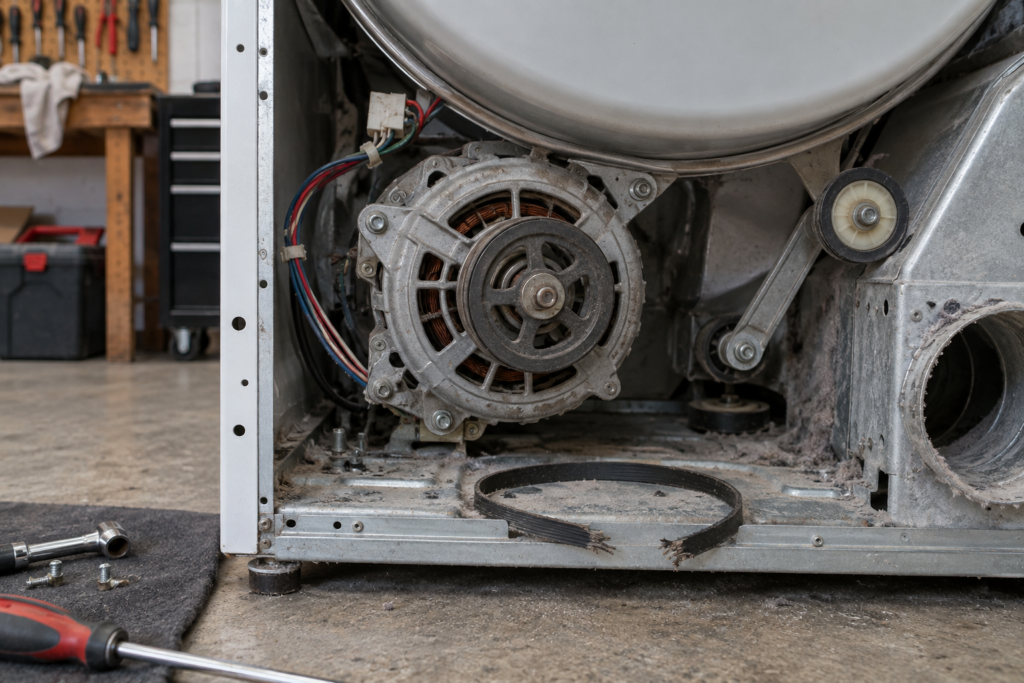
E14 means the drum motor has failed. GE's own diagnostic page for this code is direct about it, and unlike some dryer faults that can trace back to two or three different parts, E14 narrows the search to the motor itself rather than the belt, the idler pulley, or the drum support rollers — though a technician still checks those, since a jammed belt can put enough strain on the motor to trip the same code.
The giveaway symptom is a dryer that hums or clicks but the drum does not turn, or a drum that turns freely by hand when the machine is off but will not start under its own power. A dryer that heats with the drum stopped is also a safety issue on top of a repair one, since clothes sitting against a heating element without tumbling can scorch.
How Much Does It Cost to Fix a GE Dryer Drum Motor?
Repairing a confirmed drum motor failure on a GE dryer starts from $89 for the diagnostic visit, which is credited toward the repair when you go ahead. The motor itself is one of the higher-cost parts in a dryer, and the labor reflects the fact that reaching it means pulling the front or rear panel and lifting the drum out of the cabinet — this is not a bolt-on part behind an access panel. The exact total depends on your specific model and is confirmed with a written estimate before any part is ordered, in line with our policy of never quoting a firm number before a technician has the dryer open.
Is a Drum Motor Repair Worth It on an Older Dryer?
Usually yes, and the reasoning is specific to this particular fault. A drum motor is a single, well-understood part failure on a machine that is otherwise healthy — it is not the kind of repair that tends to be followed by a second, unrelated one a few months later, the way an aging control board sometimes is. If the rest of the dryer — the heating element, the vent, the door seal — is in good shape, replacing one motor is usually the more sensible move than replacing the whole appliance. Our guide to whether it is worth repairing a GE dryer covers the broader decision, including when the balance tips the other way.
- Dryer is under ten years old and otherwise fault-free: repair the motor.
- Dryer has had two or more unrelated repairs in the past year: weigh a motor repair against the cost of a new unit.
- Belt or idler pulley shows wear alongside the motor fault: replacing both in one visit avoids a second service call soon after.
- Drum bearing or rollers are also worn: factor that labor in before deciding, since it is often done at the same time.
What the Repair Visit Involves
- Diagnostic check confirms E14 traces to the motor and not a jammed belt or a blocked drum roller.
- Cabinet disassembly to reach the motor, which sits underneath or behind the drum depending on the model.
- Motor replacement, along with the belt if it shows wear from the failed motor straining against it.
- Reassembly and a full-cycle test to confirm the drum turns smoothly under load, not just when empty.
A dryer that has been running with a struggling motor for a while is also worth a look at the E14 code page itself for the exact symptom description GE uses, since a motor that is beginning to fail sometimes shows intermittent symptoms before it stops completely.
E14 Can Be Confused With a Belt or Vent Fault
Yes, and this is exactly why the diagnostic visit matters before ordering a motor. A dryer that will not tumble can also point at a snapped belt, in which case the motor spins freely but nothing turns the drum, or a heavily restricted vent, which can trip a thermal cutoff that stops the drum as a protective measure without the motor itself being at fault. A technician checks each of these before quoting a motor replacement:
- Belt continuity — a snapped belt produces a similar symptom to a dead motor for a fraction of the repair cost.
- Idler pulley tension — a seized pulley can strain the motor enough to trip E14 without the motor itself being the root cause.
- Vent restriction — a blocked vent can trigger a thermal cutoff that mimics a stalled drum.
- Drum support rollers — worn rollers make the motor work harder to turn a heavy, unbalanced load.
This is also why a repair quote for E14 sometimes comes back listing a belt or pulley alongside the motor — not as an upsell, but because those parts were found worn during the same inspection that confirmed the motor had failed. A dryer that heats while the drum is stalled is also a safety concern in its own right — see our guide to GE dryer safety and lint fires if clothes were left sitting against the heating element before the motor fault was caught.
Should You Book a Technician or Try This Yourself?
Book a technician. A drum motor sits under the drum in most GE dryer layouts, which means the repair involves lifting a heavy drum assembly out of a cabinet designed to be serviced with the right supports and clips, not improvised ones. Doing it without the correct sequence risks bending the drum or damaging the felt seals around it, turning a one-part repair into a multi-part one. Our GE dryer repair service handles the motor, belt, and drum support in a single visit, with the diagnostic fee credited toward the job. Schedule a visit or reach out with the code and we will confirm what the repair involves for your specific model before anyone comes out. Trying to shortcut the job by ordering a motor online and fitting it yourself is possible in principle, but the drum has to come out cleanly and go back in without pinching the felt seal, and a seal damaged during a rushed reassembly can turn a repair that starts from $89 into a second, avoidable one a few months later.