 David Henderson
Key Takeaways
- Four of the ten codes GE dishwashers post — C1, C2, C3 and H2O — are about water moving in or out, and most trace back to the sump filter or the drain hose.
- C4 (overfill), C7 (temperature sensor circuit) and 999 (leak in the base pan) are the three that should stop the machine until someone has looked at it.
- PF, C6 and C8 are closer to notifications than failures and usually clear without a service call.
- A code says what the control measured, not what broke — C1 means the drain took too long, not that the pump is dead.
- Write the code down before you cancel the cycle: opening the door clears most of them.
The Bottom Line
Most GE dishwasher codes point at the drain path, and the sump filter is the first thing to check on all of them. C4, C7 and 999 are the exceptions — shut the water off and book a diagnostic rather than running another cycle.
A GE dishwasher does not spell its faults out in words. It blinks a short code at you, or flashes a cycle light in a pattern, and then leaves you to work out whether the machine needs a paper towel or a technician. The codes below are the ones GE dishwashers actually post, with what each one is reporting and where a sensible check starts. Keep this GE dishwasher error codes list next to the machine the next time it stops mid-cycle.
| Code | What the control is reporting | Where to start |
|---|---|---|
| C1 | Drain cycle exceeded two minutes | Clear the sump filter and the drain hose |
| C2 | Total drain time over seven minutes | Check the air gap and the disposal inlet |
| C3 | Dishwasher will not drain at all | Stop using it; the pump or the line is blocked |
| C4 | Dishwasher overfilled | Stop using it; water can reach the floor |
| C6 | Water temperature too low | Check the house water heater setting |
| C7 | Temperature sensor circuit fault | Needs a technician; stop the cycle |
| C8 | Detergent dispenser blocked | Clear residue from the dispenser flap |
| H2O | Insufficient water supply | Open the supply valve fully |
| PF | Power failure detected | Restart the cycle after an outage |
| 999 | Leak detected in the base pan | Stop immediately and shut the water off |
How These Codes Show Up on Your Machine
Not every GE dishwasher has a digital readout. On models with a display, the code appears directly where the time remaining normally sits. On models with only a row of cycle buttons, the same fault is reported by a blinking light, usually the one nearest the start button, and the number of flashes stands in for the digit.
Two things are worth knowing before you read anything into a code. First, the control clears most codes when the door is opened and the cycle cancelled, so write down what you saw before you touch anything. Second, the code describes what the control measured, not what broke. C1 says the drain took too long. It does not say whether the filter is packed, the hose is kinked, or the pump is failing, and a technician still has to find out which.
The Drain Codes Are Four Out of Ten
C1, C2 and C3 all describe the same event at three levels of severity: water that should have left the tub did not leave it fast enough, or did not leave at all. They are by far the most common codes on this list, and they are the ones most likely to have a cause you can reach yourself.
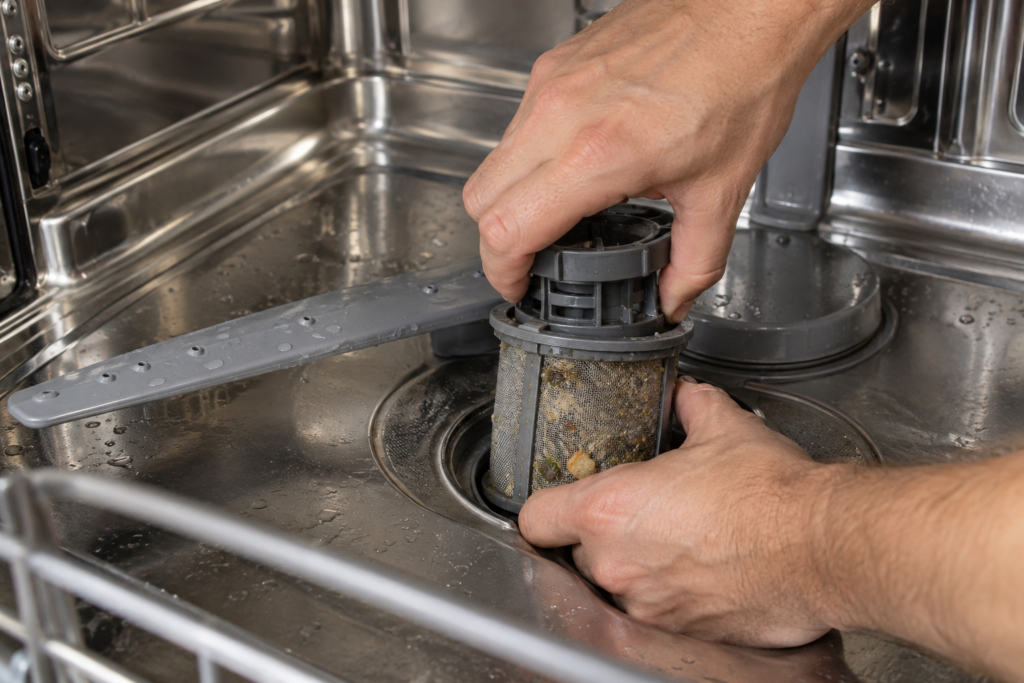
- The sump filter. On most current GE dishwashers the filter twists out of the floor of the tub by hand. Food debris packed against the mesh is the single most frequent cause of a slow drain.
- The drain hose. It has to rise into a high loop or an air gap before it drops to the disposal. A hose that sags or has been crushed behind the cabinet will read as a slow drain forever.
- The disposal inlet. A new garbage disposal ships with the dishwasher knockout plug still in place. If your machine started reporting drain faults right after a disposal was replaced, that plug is the first thing to check.
- The pump itself. Glass chips, a fruit pit or a bit of wire tie can jam the impeller. This is where the check stops being a do-it-yourself job.
A C1 fault that returns after every wash, with the filter already clean, is pointing past the easy causes. Our guide to a GE dishwasher that will not drain walks through the whole path in order.
Three Codes That Mean Stop Now
Most of this list can wait until the weekend. Three entries cannot.
C4 reports an overfill. The control has measured more water in the tub than the cycle called for, which usually means the inlet valve is not closing or the level sensor has lost its reference. Either way the machine is capable of putting water on your floor, and it should not be run again until someone has looked at it. Shut the supply valve under the sink.
The 999 code is the leak sensor in the base pan reporting water where there should be none. On models fitted with an active leak protection system, the machine will also try to pump itself dry and refuse to restart. Do not defeat it. A base pan that is wet means water has already left the tub or a hose connection.
C7 is a temperature sensor circuit fault. It matters less because of the temperature and more because the control is now running blind on a heating circuit, and a heater with no reliable sensor behind it is not something to leave running unattended.
The Codes That Are Really Just Messages
Three entries are closer to notifications than faults. PF simply records that power was interrupted mid-cycle; after an outage or a tripped breaker it means nothing more than that, and restarting the cycle clears it. If PF keeps appearing with no outage in the house, the problem is in the outlet or the branch circuit rather than in the dishwasher.
C6 reports incoming water that is colder than the cycle expects. GE dishwashers heat their own water, but they start from whatever the house supplies, and a water heater set low, or a long run of pipe from the heater to the kitchen, will trigger it. Running the kitchen tap hot before starting the machine is a legitimate fix.
C8 says the detergent dispenser flap did not open, which after a few months is almost always caked detergent around the hinge rather than a broken latch. Warm water and an old toothbrush deal with most of them. H2O belongs in the same group: the supply valve is partly closed, the inlet screen is silted up, or the house pressure dropped.
What To Do Before You Book Anything
Codes are worth much more to a technician when they come with context, and gathering it takes five minutes.
- Write the code down exactly, including whether it appeared at the start, mid-cycle, or at the end.
- Note what the tub looked like — standing water, an empty tub, or water above the filter.
- Pull and rinse the sump filter, then run a short cycle and see whether the same code returns.
- Check the drain hose loop and the disposal inlet if the code was in the C1 to C3 group.
- Stop there if the code was C4, C7 or 999 — those three are not worth experimenting with.
If the fault survives all of that, our GE dishwasher repair service covers the drain circuit, the inlet valve, the sensors and the control board in one visit. Diagnostic work starts from $89, and what a specific fault costs to put right is set out in our guide to GE error code repair costs. The final price is confirmed after the on-site diagnosis, and you get a written estimate before any work begins — you can book a visit or send us the code and we will tell you whether it is worth one.