 David Henderson
Key Takeaways
- GE oven DIY repair is limited to checks from the outside: the code, the breaker, the keypad and skipping self-clean.
- A five-minute reset at the dedicated breaker clears a one-time fault, but it cannot repair a failed part.
- A half-tripped double-pole breaker mimics a dead oven, so check it before anything else.
- Sensors, latch motors, fans and control boards are technician jobs, because a wall oven is wired to 240 volts.
- A service manual assumes training and test equipment; it does not make a live-circuit repair safe at home.
The Bottom Line
Record the code, reset once at the breaker, check the supply and dry the keypad, then leave everything with a part in it to a technician. The price is confirmed after diagnosis, with a written estimate before work begins.
GE ovens are built for people to cook in, not to open up, and the line between a safe check and a dangerous one is sharper than on most appliances. A wall oven is wired to 240 volts, the control sits behind the panel and the heating parts run at temperatures that can ignite a mistake. That leaves a smaller list of things worth trying yourself than the internet suggests, but it is a useful list, and it can save a visit.
| Task | Safe to do yourself? | Why |
|---|---|---|
| Note the code and what the oven was doing | Yes | The most useful information a technician can get |
| Reset at the breaker for five minutes | Yes | Clears a one-time fault from a voltage dip |
| Check the breaker is fully on | Yes | A half-tripped breaker mimics a dead oven |
| Dry the keypad with a cloth | Yes | Moisture shorts the touchpad |
| Skip self-clean with a latch code | Yes | Baking does not use the door lock |
| Open the control panel or the junction box | No | Live 240 volt wiring and capacitors |
| Replace a sensor, latch motor or board | No | Needs testing, the right part and a safe install |
What Can You Safely Fix Yourself on a GE Oven?
You can fix almost nothing inside it, but you can rule out several causes from the outside, and that is where GE oven DIY repair stops being a risk and starts saving money. Every code page on this site lists safe checks that need no disassembly, and the same short list applies across most codes: record it, reset it once, check the supply and look at the keypad.
The pages also say plainly where the safe checks end. Anything that means removing panels, reaching the control area or testing wiring is marked as a technician's job, and for a wall oven that includes the junction box, because the house wiring connects there.
Is It Safe to Reset a GE Oven at the Breaker?
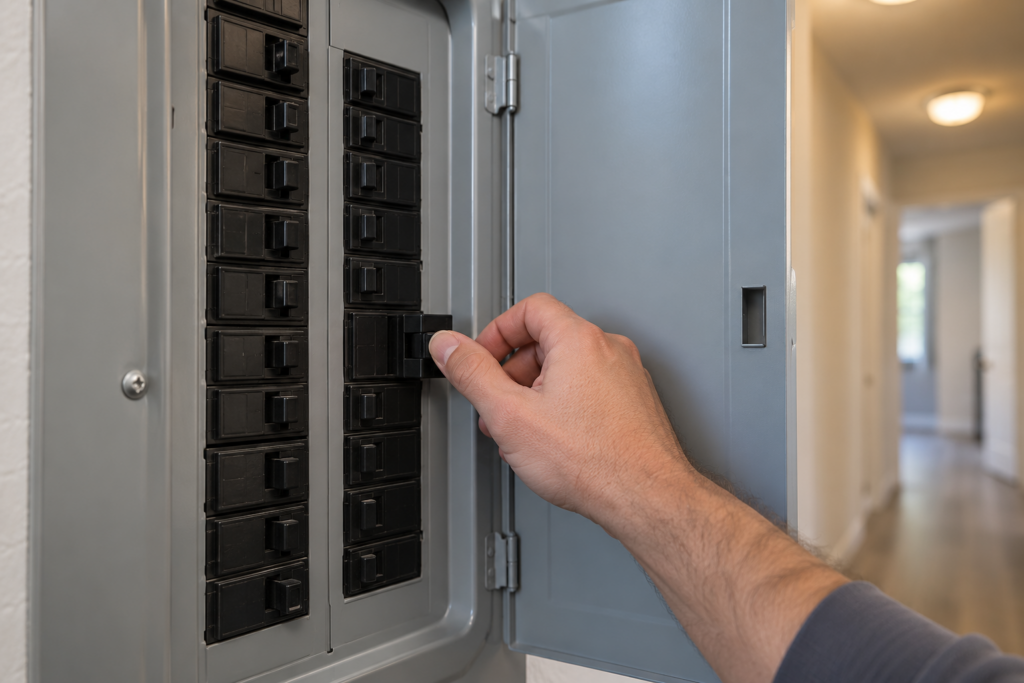
Yes, for the circuit breaker, and it is the one reset the code pages recommend again and again. Switch the oven's dedicated breaker fully off for five minutes, which lets the control board discharge, then restore power and watch whether the code comes back on its own or only when you start a cook mode. A voltage dip or a surge can cause a one-time fault that clears this way.
What a reset cannot do is repair a part. If the code returns at once, a sensor has burned out, a key is stuck or a board has failed, and further resets only delay the diagnosis. Do not use the breaker to keep an oven running through a code the page marks as stop, and do not repeat the reset more than once: a code that survives one proper reset is a fault, and the second and third attempts only teach you what the first one already did.
Safe Checks by Symptom
Match what you see to the check that costs nothing, and stop there if it does not help.
- Dead oven, blank display. Confirm the double-pole breaker is fully on. The FF page says a completely dead oven is more often a tripped breaker than a failed board.
- Keys ignored, or a function starting alone. Dry the touchpad with a cloth and avoid sprays; the F7 page covers a shorted key.
- Self-clean will not lock. Skip self-clean and keep baking; the F9 page and the F5 page explain the latch.
- Oven does not heat evenly or at all. Start with our guide to a GE oven that is not heating before assuming a part has failed.
Which GE Oven Repairs Need a Technician?
Every repair that involves a part, and every code the pages mark as stop. The reasons are the same each time: the control can no longer be sure what the elements are doing, and an oven built into a cabinet is a poor place to find out.
- F1 and FF. The control board has failed; board replacement is the only fix.
- F3 and F4. The temperature sensor is open or shorted, and a technician tests and replaces it.
- F2. The cavity passed its safety limit, roughly 590 degrees Fahrenheit during normal baking on the wall oven page, which is a fire risk.
- F96. The cooling fan is not running, and the board can overheat.
- F5 and F9. The latch motor or its wiring needs repair before self-clean is used again.
What Not to Attempt on an Oven
A few jobs look easy on a video and are not. Wall ovens are permanently wired, so there is no plug to pull, and the breaker is the only isolation you have.
- Opening the control panel. Capacitors on the board hold charge and the wiring is high voltage.
- Bypassing a sensor. A shorted sensor makes the oven run uncontrolled, as the F4 page warns.
- Checking the junction box without experience. The page says to call an electrician or technician if you are not comfortable with 240 volt wiring.
- Self-clean on a faulty latch. It needs the door locked at very high temperature.
What to Tell the Technician
The checks above are worth doing even when they fix nothing, because their results are the most useful thing you can hand over. A technician who knows what happened before the visit arrives with the right part, and a shorter visit is a cheaper one.
- The exact code and when it appeared. At power-up, during preheat or only in a particular mode.
- What the reset did. Whether the code stayed away, returned at once or returned after a cook cycle.
- The breaker position. A note that it was fully on, so the supply is already ruled out.
- The model number. From the label on the oven frame, because parts differ between lines.
If the oven is a wall oven, say whether it is a single or a double, and say whether the code appeared on both cavities. On a double wall oven one board can serve both cavities, and a code on both at once points at the board rather than at one element.
Does a Repair Manual Change the Answer?
Not much. A service manual is written for trained technicians and assumes test equipment, the right replacement parts and training in live-circuit work. It can help you understand what a technician is doing, but it does not make a 240 volt repair safe for a homeowner, and it does not tell you whether the repair is worth its price.
What helps more is a record of the code, the model number and when the fault started. Our GE oven repair cost guide shows what each repair tends to cost, and the guide to whether to repair or replace a GE oven covers the larger decision. Oven repair and range repair cover every code above. The price is confirmed on site after diagnosis, with a written estimate before any part is ordered; schedule a visit or contact us with the code and the model number.